Course offering: Unwinding Whiteness

I’m excited to be offering the Fall 2025 cohort of Unwinding Whiteness for Healing Practitioners with my dear friend Mikai’el Jade. This course emerged out of a peer-led group Jade and I are part of that’s been meeting since 2021 to explore the ways racism lives inside us as white people and how to start unwinding that programming. Jade and I decided we wanted to bring some of the practices we learned in this group out into the world, so we spent almost a year developing a curriculum together.

Unwinding Whiteness is a small group space where we’ll work with the characteristics of white supremacy from Tema Okun and Kenneth Jones’ famous essay, “White Supremacy Culture” — observing how these traits show up in our bodies, our practices, and our work with clients, and beginning to unwind them together.

We first offered this class last Spring and we got great feedback. The somatic practices allowed for deep self reflection, and the intimacy of the cohort facilitated vulnerable and powerful healing in community. We’re looking forward to offering the next round starting in October, and we’d love to have you join us.

More details and registration here

Changing my Covid policy

Since the start of the pandemic, I’ve been requiring that both myself and my surrogate partner therapy clients take a Covid test before each session. Starting in 2025, I’ve decided to stop requiring Covid tests before we meet. I want to emphasize that I did not make this change to my Covid policy because I think Covid is no longer “a big deal;” the only reason I’m changing this policy is that I’ve found rapid tests have not been effective at preventing exposures.

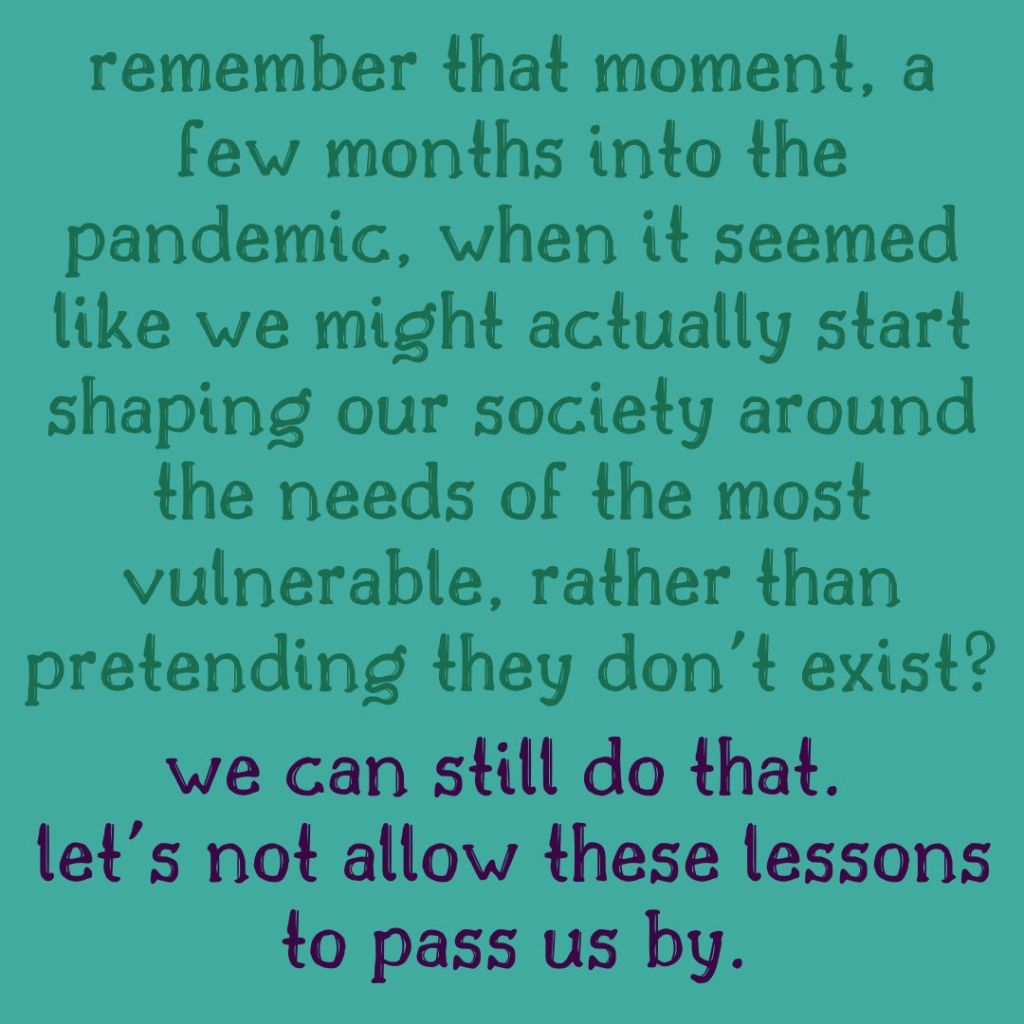
I still take Covid — and all transmissible illnesses — very seriously. The pandemic opened my eyes to the ways our society systemically dismisses and ignores those with chronic illness and disability (I strongly recommend this article on “The Great Forgetting” by badass disabled activist and writer Leah Lakshmi Piepzna-Samarasinha). Rather than waiting for the pandemic to “be over” so I could go back to my normal life, I started shifting the way I moved through the world.

An Instagram post I made on this topic in early 2023. Click to read the whole post.

I used to be someone who never got the flu shot; I thought to myself, “I’ll be fine if I get the flu — I’d rather get it than deal with getting the vaccine.” The thing is, it’s not about you in specific and how you’ll fare if you get sick. It’s about all the people you might pass an illness to: at the grocery store, in the elevator, via the gas pump or sink faucet you touched. The chronically ill, disabled, and elderly folks who are much more vulnerable than you.

The reality is that 40 percent of Americans have multiple comorbidities, so the myth that the CDC perpetuated when it ended Covid restrictions in 2023 — that most of us will be totally fine now that we have the vaccine — is patently false. As of April 2024, roughly 17 million Americans were still grappling with effects of long Covid. When are we going to stop treating people with disability and chronic illness like they’re some strange outlier and recognize that they’re our neighbors, our friends, our family members — and often ourselves? It’s high time we actually start centering the needs of the most vulnerable in the way we structure our society.

I am still taking many precautions against Covid and other transmissible illnesses like the flu; I wear a mask inside stores, I stay home and avoid indoor hangs if I have symptoms of an illness, I wash my hands every time I come home, I get my vaccines, and I’m still limiting how frequently I eat indoors at restaurants.

While I know many of my clients are not taking the same precautions I am, I do expect them to take my health and needs seriously — just as one would with a partner. My job carries specific risks if I get sick; I stand to expose many clients and lose a significant chunk of income if I fall ill. For clients who don’t have a private practice and don’t do such physically intimate work, those impacts might not be obvious.

Covid policy for clients

I expect my clients to inform me if they have any symptoms of an illness, like the sniffles, a sore throat, or nausea, so that we can decide together if it feels safe enough to meet. I always offer online sessions when an in-person session is not possible — and trust me, there’s plenty we can do together online — so being sick doesn’t mean we have to miss out on connection.

I request that my clients take reasonable precautions in the 3 – 4 days before our session: wearing a mask while commuting on public transportation, at indoor exercise classes, or while attending indoor events with more than 12 people; avoiding high-risk environments like restaurants, bars, and clubs; and not spending time with friends or loved ones who are presenting symptoms.

I strongly encourage my clients to get vaccinated every fall, against both Covid and the flu. I recommend the Novavax vaccine, which is widely reported to have far fewer side effects than the vaccines that were available early on, like Pfizer and Moderna — and that was certainly my experience of it.

A note on my personal experience of the Novavax vaccine: The effects of my first three vaccine shots were so extreme (not only flu-like symptoms for the day or two afterward, but the vaccines also disrupted my menstruation cycle for about a year after each shot and gave me extreme cramping with every cycle), that I actually didn’t get my vaccine in 2023 — I decided the benefits were not worth the negative impacts. When I heard reports that the Novavax vaccine had far less severe side effects, I decided to give it a shot (pun intended). I was blown away. The only symptoms I experienced the next day were some mild aching in my arm and a little bit of tiredness. I did not have any flu-like symptoms; despite having cleared my schedule to stay in bed all day, I ended up going on a long walk in the woods with my dog and running several errands. And best of all, it’s had absolutely no noticeable impact on my period.

TLDR

Covid is not over. Transmissible illnesses, like Covid and the flu, still cause serious health issues for millions of Americans, especially those who are chronically ill and disabled. Rather than going “back to normal,” we can all take reasonable harm reduction steps to protect the most vulnerable in our society.

My asks of my clients:

  • Inform me if you have any symptoms of an illness before our session
  • In the 3 – 4 days before our session:
    • mask while on public transportation, at indoor exercise classes, or attending indoor events with more than 12 people
    • avoid high-risk environments like restaurants, bars, and clubs
    • avoid spending time with people who have symptoms of illness
  • If possible, get the Novavax vaccine (which rarely causes severe side effects the way other vaccines do)

What’s the difference between a coach and a therapist in the surrogate partner therapy triad?

Surrogate partner therapy relies on a triadic model, which means in addition to the surrogate partner, a client must also be working with a therapist or coach. There are some big differences between therapy and coaching, and clients aren’t always sure which one is best for them.

As a surrogate partner, I have worked with both coaches and therapists, and have had great cases and cases that didn’t go so well with both. I don’t have a strong preference toward either; the choice is really about what suits a client’s needs. So what are the differences?

Therapy

Therapy has a strict licensure process. In order to get licensed, therapists have to complete graduate level education, finish thousands of hours of training, and stick to very clear ethical standards in their practice. Therapy licensure is state-by-state (every state has different requirements) and in general therapists aren’t legally allowed to work with clients outside their state.

The extensive training and strict ethical standards therapists must abide by can provide a sense of safety for some clients. Those strict rules can also make some therapists balk at the sexual element of surrogate partner therapy and feel hesitant (or outright refuse) to work in the surrogate partner therapy triad. That being said, I have worked with many therapists who are enthusiastic about surrogate partner therapy right from the get-go — and have also seen many therapists who were initially hesitant about surrogate partner therapy change tune as soon as they saw the value of the work.

In terms of cost, many health insurance companies cover the cost of therapy, or charge a small co-pay, for therapists who are in-network, which can save clients thousands of dollars over time. That being said, it can often be tough to find a therapist your health insurance covers who has availability in their practice and is open to collaborating with a surrogate partner.

On the therapist’s end, dealing with insurance companies sucks; it requires a huge amount of time, labor, and bureaucracy navigation to become approved by an insurance provider, and to receive compensation for each session with a client. For this reason, many talented therapists don’t work with insurance companies. Out of pocket, therapists can be quite expensive.

Coaching

Unlike with therapy, there is no formal licensure or training process for coaching. Although there are coaching certification programs available, completing one is not required in order to use the title of “coach” — essentially, anyone can call themselves a coach. Coaches are not required to adhere to strict licensure standards the way therapists are.

This provides a lot more flexibility in a coach’s practice, and for this reason, many people trained as therapists decide not to go the licensed-therapist route and instead offer coaching. But it also sometimes means folks who aren’t very ethical offer coaching. As a surrogate partner, I tend to vet the coaches I work with a little harder than therapists; I want to ensure they have sufficient experience to support a client competently. (I will note: in my eight years as a surrogate, I’ve encountered just as many therapists as coaches — if not more — who operate in ways that seem unethical to me. The strict requirements of licensure are not a guarantee of ethical practice.)

When it comes to cost, coaches are rarely covered by insurance, so working with one can add up over time.

I find coaches (particularly sex coaches, or at least coaches who advertise themselves as “sex positive”) are often more open to working in the surrogate partner therapy triad than licensed therapists — but not always. When clients already have a therapist but the therapist has said they’re unwilling to collaborate in the surrogate partner therapy triad, I often recommend finding a sex coach for the duration of our work.

I have a few other blog posts on the topic of therapists:


Podcast Interview with Modern Anarchy

My interview with Nicole Thompson of Modern Anarchy Podcast just dropped. Nicole and I had a rich, flowing conversation on solo polyamory, surrogate partner therapy, whorephobia, the line between work and pleasure, and, of course, healing. I tend to be pretty embarrassed listening to my own podcast interviews but I have to say I actually quite enjoyed this one! It was a delight to be interviewed and a delight to listen to again. Thanks for having me, Nicole.

Listen to the podcast here.

My favorite meditations: “Queer Practice – Trust the Roots”

Happy Pride y’all! To celebrate Pride month, I’m sharing one of my all-time favorite meditations, from Buddhist teacher Michael Lobsang Tenpa. This meditation is specifically for queer folks; it guides us to find our roots at a time when our rights are being threatened across the nation and around the world.

This meditation has been a touchstone for me. I turn to it anytime I feel a lack of belonging in this normative world. Lobsang Tenpa’s invitation to call in support from our ancestors, loved ones, and from the earth helps me get grounded in a way few things do when I’m feeling triggered. I hope this meditation offers you as much solace as it’s brought me:

Queer Practice: Trust the Roots on Insight Timer